Across Northern California's foothills, the Tahoe basin, and the wine country, wildfire is a design constraint, not a rare event. "Home hardening" is the building-science practice of upgrading a home's exterior — its roof, vents, siding, windows, and decks — and managing the space around it so the structure is far less likely to ignite when fire or embers reach it. It is one of the most consequential things a homeowner in a fire-prone area can do.
This guide brings together what the research shows about how homes catch fire, the defensible-space zones California uses, and the specific exterior upgrades that reduce ignition risk under CBC Chapter 7A and Cal Fire guidance. It draws on full-scale testing from the Insurance Institute for Business & Home Safety (IBHS), research from Headwaters Economics and UC Agriculture & Natural Resources, and California's official wildfire program. One thing we will not tell you is that any home is "fireproof" — no home is. The honest goal is to reduce ignition risk and meet or exceed code.
The building science here comes from primary sources, including full-scale testing by the Insurance Institute for Business & Home Safety (IBHS), research from UC Agriculture & Natural Resources, and California's official Cal Fire Ready for Wildfire program.
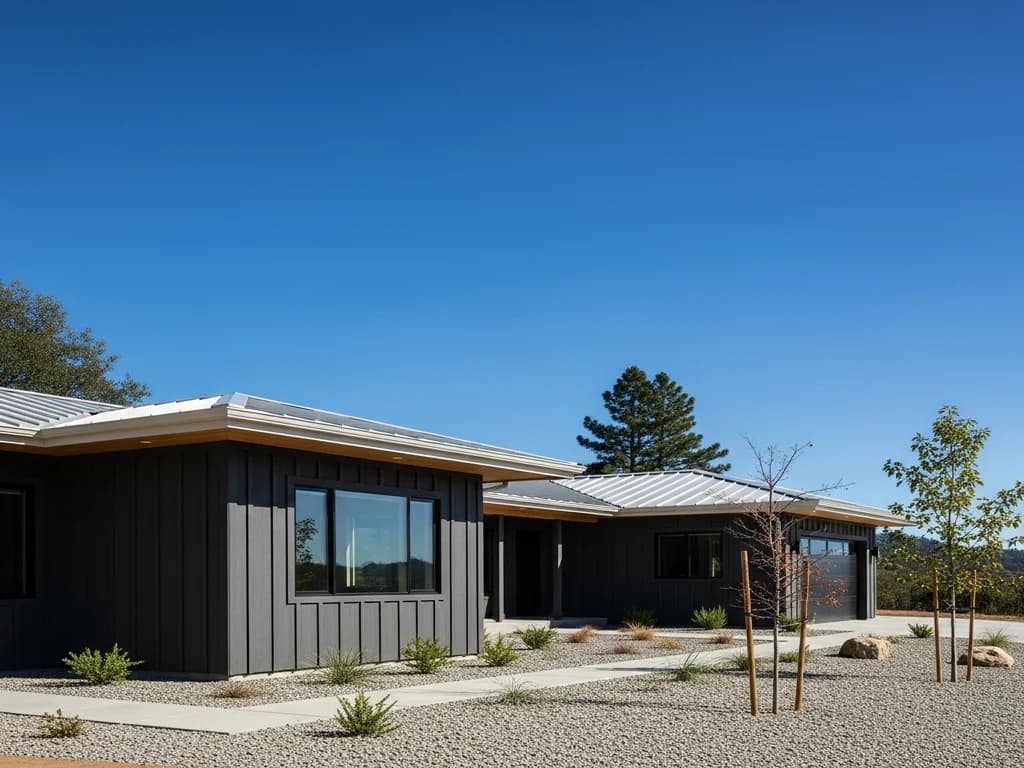
Understanding how homes actually catch fire is what makes hardening effective. Building-science research points to three mechanisms, and the first is by far the most important.
Embers (the biggest threat)
Research from IBHS and fire scientists consistently finds that wind-driven embers — not the flame front itself — ignite the majority of homes in a wildfire. Embers can travel well ahead of a fire, land on a roof or deck, collect against a wall, or blow through a vent into an attic. Hardening focuses heavily on denying embers a place to start a fire.
Direct flame contact
Flames from burning vegetation, a fence, or a neighboring structure can reach a home directly. Keeping combustible material away from walls and using ignition-resistant siding and decking reduces how easily direct flame can take hold.
Radiant heat
Intense heat from nearby fire can crack windows and ignite materials without direct contact. Tempered or multi-pane glazing and non-combustible surfaces near the home help the structure withstand that heat.
Because embers do the most damage, IBHS research frames hardening around denying them any place to start — a principle that runs through every section below.
Hardening the structure works hand in hand with managing the space around it. California's Ready for Wildfire program organizes that space into three zones, working outward from the wall.
The most critical and newest zone: the 5 feet immediately around the home. The goal is to keep it as non-combustible as possible — no bark mulch, firewood, dead plants, or combustible items against the wall, and hard surfaces or bare, irrigated ground instead. This is where embers most often start a home on fire, and Cal Fire treats it as the highest priority.
Within 30 feet of the home, remove dead vegetation, keep grass low, space shrubs and trees, and prune branches away from the house and each other. The idea is to break up the fuel so fire cannot travel continuously toward the structure.
Out to 100 feet (or the property line), thin vegetation, remove ladder fuels that let fire climb into tree canopies, and keep the landscape discontinuous. Zone 2 slows a fire's approach and lowers the intensity that reaches the home.
For the authoritative details and current requirements, see Cal Fire's defensible-space guidance. We focus on the structure; a landscape professional can help with the vegetation side.
The top of the house is where embers land and collect, so the roofline is the first structural priority.
The roof
The roof is the largest surface embers land on, so a Class A fire-rated roof assembly is foundational. Keeping gutters and the roof surface free of leaves and needles removes the fine fuel embers ignite most easily.
Vents
Attic and crawlspace vents are a common ember entry point. Ember- and flame-resistant vents, or finer non-combustible mesh screening as allowed by code, help keep embers out of concealed spaces where they can smolder unseen. The State Fire Marshal maintains listings of building materials and components tested for the wildland-urban interface.
Eaves, soffits, and fascia
Open eaves can trap rising embers and heat. Enclosing eaves ('boxing them in') and using ignition-resistant soffit and fascia materials reduces the number of vulnerable openings and combustible edges near the roofline.
Compliant vents and components are tracked in the California Office of the State Fire Marshal building-materials listings, which enforce CBC Chapter 7A requirements.
The walls are a large surface exposed to embers, radiant heat, and sometimes direct flame. In a designated wildland-urban interface (WUI) or high fire-hazard zone, CBC Chapter 7A requires ignition-resistant exterior materials — and even where it is not required, ignition-resistant siding is one of the more valuable structural upgrades.
Non-combustible and ignition-resistant claddings such as fiber cement resist flame and heat far better than untreated wood. Our guide to wildfire-resistant siding in California and our fiber cement vs. vinyl vs. engineered wood comparison walk through how the materials differ, and our James Hardie fiber cement service covers installation. We confirm what Chapter 7A requires for your zone before recommending a material.
Two more exterior elements are common points of failure — and both are addressable during a remodel.
Windows
Windows can fail from radiant heat before flames ever touch the house, opening a path for embers indoors. Multi-pane glazing, with tempered glass where appropriate, is far more resistant to heat-induced cracking than older single-pane windows — one reason window replacement is a meaningful hardening upgrade.
Decks and attachments
A combustible deck, fence, or attached structure can act as a fuse that carries fire to the house. Ignition-resistant or non-combustible decking, keeping the area under and around a deck clear of debris and stored combustibles, and detailing where a deck meets the wall all reduce that risk. In California, elevated decks and balconies on multifamily buildings also carry SB 326/721 inspection requirements.
See our window replacement and deck & balcony inspection services for how we address each.
Home hardening reduces ignition risk; it does not make a home fireproof, and no honest contractor will tell you otherwise. Wildfire behavior depends on weather, fuel, and terrain that no upgrade controls. What hardening does is stack the odds in your favor — a home with a Class A roof, ember-resistant vents, non-combustible near-home surfaces, ignition-resistant siding, and a maintained defensible space is far less likely to ignite than one without, and that difference can be decisive.
Because embers can find the single weakest point, hardening works best as a system rather than a single product. Research from IBHS and Headwaters Economics emphasizes combining structure upgrades with the near-home zone, and points out that many of the highest-value measures — vent screening, cleaning the roof and gutters, clearing the first five feet — are among the least expensive. We help you prioritize the upgrades that meet or exceed code and address your home's specific vulnerabilities, and we describe the result honestly: reduced ignition risk, not immunity.
An honest promise
We never say a home is fireproof, and we never guarantee a home will survive a wildfire. What we do is reduce ignition risk with upgrades that meet or exceed code, prioritize the measures that matter most for your specific home, and describe the result honestly. Research from Headwaters Economics also shows that many of the highest-value measures are among the least expensive.
Wildfire risk looks different across the region we serve. In the Placer and El Dorado foothills — Auburn, El Dorado Hills, Grass Valley, and the communities around them — many homes sit in designated fire-hazard zones where CBC Chapter 7A applies and where ember exposure from surrounding vegetation is high. In the Tahoe and Truckee area, forested lots and dense tree canopy raise the stakes, and ignition-resistant siding and roofing are common upgrades. In the wine country around Napa, recent fire history has made hardening a priority for many homeowners rebuilding or renovating.
Wherever your home is, we confirm its fire-hazard designation and what Chapter 7A requires before scoping work, and we hold to the same rule: reduce ignition risk, meet or exceed code, and never overstate what a hardened home can withstand. See the cities we serve, including Auburn, El Dorado Hills, Truckee, Grass Valley, and Napa.