What Truckee & Tahoe Siding Has to Survive
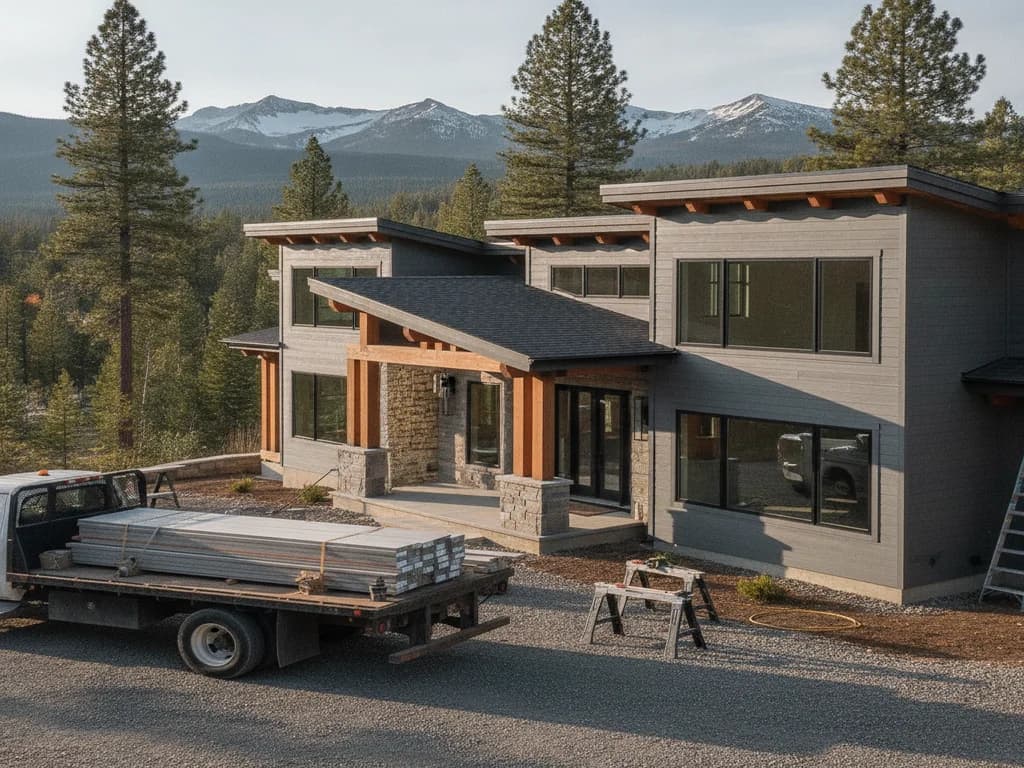
Siding at 6,000 feet lives a harder life than siding almost anywhere else in California. Homes in Truckee, Tahoe City, and around the lake face a punishing combination: repeated freeze-thaw cycling, multi-foot snow loads, ice damming, intense high-altitude UV, and — increasingly — wildfire exposure in a designated Wildland-Urban Interface (WUI). Any siding that absorbs water is vulnerable, because trapped moisture expands as it freezes and works relentlessly at seams and edges.
That mix of pressures is exactly why so many Truckee and Tahoe homeowners choose fiber cement siding, most commonly James Hardie. It is dimensionally stable, noncombustible, and offered in a climate-specific formulation engineered for the high Sierra. Here are seven reasons it has become the default recommendation for mountain homes across the basin.
1. It Shrugs Off Freeze-Thaw Cycling
Water is the enemy at elevation — fiber cement barely absorbs it
A Truckee winter can swing above and below freezing dozens of times, and every cycle is a stress test for the walls. Materials that soak up water swell, crack, and delaminate as that moisture freezes and expands. Fiber cement absorbs very little moisture, so it stays dimensionally stable through the constant freeze-thaw churn that defines the Tahoe basin.
That stability is why it outlasts many wood and wood-composite products at elevation — there is simply nothing for the ice to pry apart at the seams and cut edges.
2. It Handles Snow, Ice, and Heavy Moisture
Built for months of snowpack against the wall
Around the lake, snow piles against the lower walls for months and meltwater runs behind anything that is not detailed correctly. Fiber cement does not rot, swell, or lose strength when it sits wet, which matters where snowpack lingers against the siding well into spring.
The material is only as good as its installation, though. Correct clearances above grade and snow-shed surfaces, proper flashing, and a well-built drainage plane behind the siding are essential — see our moisture barrier and flashing guide for why the assembly behind the wall matters as much as the plank on it.
3. It Is Noncombustible for WUI Fire Zones
Ignition-resistant walls in a designated fire zone
The Tahoe basin and the forests around Truckee are high-hazard WUI territory, and new construction there must meet California Building Code Chapter 7A, which requires ignition-resistant exterior walls. Fiber cement is noncombustible — it does not ignite — which makes it a leading choice for Chapter 7A compliance and a smart voluntary upgrade on older cabins.
To be honest about it: noncombustible siding does not make a home fireproof, and no material eliminates wildfire risk. What it does is remove one of the surfaces wind-blown embers try to ignite, which is why it pairs naturally with a broader home hardening plan and our wildfire-resistant siding guide.
4. The HZ5 Formulation Is Built for the High Sierra
Match the product to the elevation
James Hardie engineers climate-specific formulations. HZ10 is designed for most of California, where heat and UV dominate. HZ5 is engineered for the high Sierra and Tahoe basin, where freeze-thaw cycling and heavy snow load are the governing conditions. Using the HZ5 product matched to the mountains helps the siding perform as intended over decades.
This is a detail a valley-based contractor can miss. For Truckee and Tahoe projects, HZ5 is the right call, and confirming the correct formulation is part of how we scope any mountain-home siding job.
5. Factory Color Holds Up to Alpine UV
High-altitude sun is brutal on finishes
UV intensity climbs with elevation, and south- and west-facing walls at Tahoe take a beating that fades field paint quickly. Fiber cement's factory-applied finishes are baked on under controlled conditions and hold their color far longer than paint brushed on at the jobsite.
For mountain homeowners that means fewer repaint cycles on hard-to-reach alpine elevations, and a facade that keeps its look through years of intense sun and reflected glare off the snow.
6. It Resists Rot, Pests, and Moisture Damage
Nothing for insects or fungus to feed on
Cement, sand, and cellulose fiber give carpenter ants, termites, and wood-decay fungi nothing to eat. In a damp, forested environment where wood siding can quietly rot behind the paint, that resistance translates into a wall that keeps its integrity year after year.
Combined with its freeze-thaw stability, this is a big part of why fiber cement tends to need far fewer repairs than wood or wood-composite siding on a Tahoe-area home.
7. Low Maintenance and Strong Long-Run Value
Higher upfront cost, lower cost of ownership
Fiber cement costs more up front than vinyl and requires experienced installers with the right tools — nailing patterns, clearances, and flashing must be correct or both performance and warranty coverage suffer. But across a mountain home's long life, the durability, fire resistance, color retention, and low maintenance often make it the better long-run value.
Costs vary widely with your home's size, elevation, access, and detailing, so a walk-around of your actual walls beats any generic per-foot figure — our siding cost guide explains what drives the number. When you are ready, our James Hardie siding and siding installation teams can scope your project, or you can request a free estimate. For the bigger picture on mountain projects, see our Tahoe and Truckee remodeling guide.
What is the difference between James Hardie HZ5 and HZ10 for Tahoe homes?
James Hardie makes climate-specific formulations. HZ10 is designed for most of California, where heat and UV are the dominant stresses. HZ5 is engineered for the high Sierra and Tahoe basin, where freeze-thaw cycling and heavy snow load govern. For Truckee and Tahoe City homes, HZ5 is the correct product because it is built for the mountain conditions your siding actually faces.
Is fiber cement siding worth the extra cost at elevation?
For most Tahoe and Truckee homes, yes. Fiber cement costs more up front than vinyl, but it resists freeze-thaw damage, does not rot or feed pests, is noncombustible for WUI fire zones, and holds factory color under intense alpine UV. Over a mountain home's long life those qualities usually make it the better long-run value, especially given the difficulty and cost of repairs at elevation.
Does fiber cement siding make a mountain home fireproof?
No. Fiber cement is noncombustible, meaning it does not ignite, but no siding makes a home fireproof and no material eliminates wildfire risk. It removes one of the surfaces embers try to ignite, which is why it supports Chapter 7A compliance and pairs well with a full home-hardening plan covering vents, roof, decks, and defensible space.
Can fiber cement be installed in winter at Tahoe?
Installation is possible in colder months, but snow, ice, and short daylight windows make scheduling and proper detailing harder, and correct flashing and drainage-plane work is critical at elevation. Many Truckee and Tahoe siding projects are planned for the drier late-spring-through-fall window. We scope each mountain job around access, weather, and the correct HZ5 product before setting a schedule.