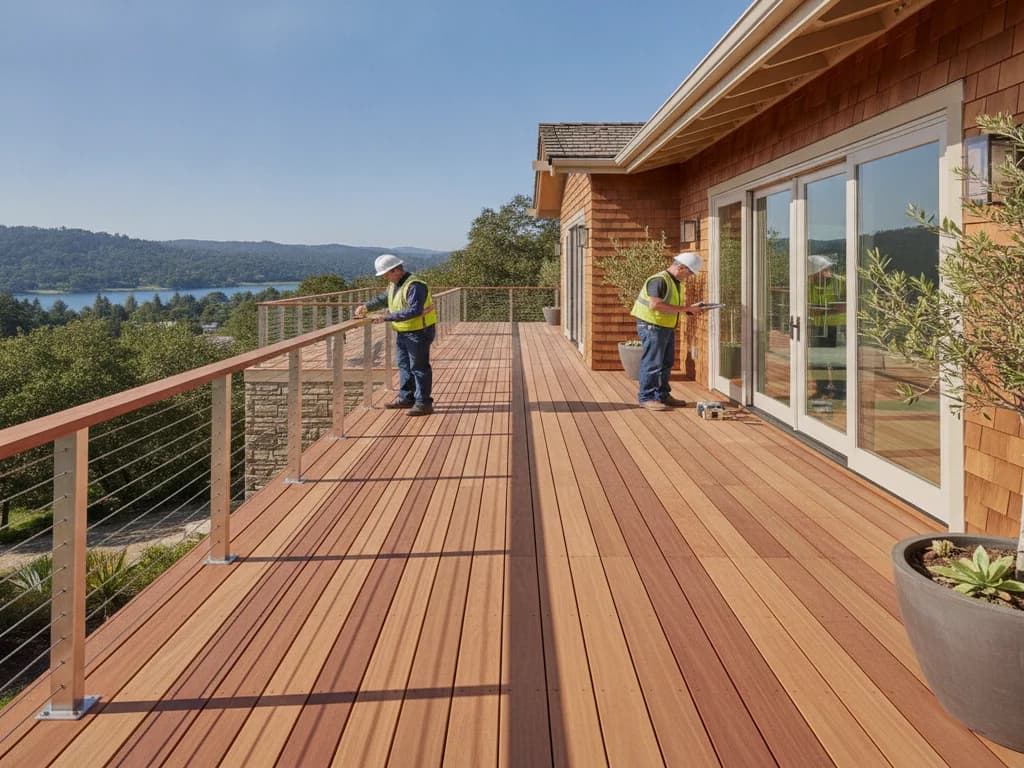
Deck & Balcony Inspection Repair in Northern California
California law now requires many multifamily buildings to inspect their elevated decks, balconies, stairways, and walkways on a set schedule — SB 326 for condos and HOAs under the Davis-Stirling Act, and SB 721 for apartment buildings with three or more units. These "exterior elevated element" (EEE) inspections exist because concealed water intrusion and dry rot in load-bearing wood can lead to sudden, dangerous failures. Our team performs the repair and reconstruction side — opening up, waterproofing, and rebuilding elements flagged by an inspection so they're safe and sound.
- Repair of decks, balconies, stairways, and walkways flagged by EEE inspection
- Support for SB 326 (condo/HOA) and SB 721 (apartment) compliance work
- Investigation of concealed, load-bearing, weather-exposed wood elements
- Dry-rot and structural repair of framing and supports
- Waterproofing membranes, flashing, and proper drainage detailing
- Deck surface, railing, and guardrail replacement
- Coordination with your inspecting architect or engineer
- Documentation of repairs for your association or ownership records
- Non-combustible and ignition-resistant materials where fire-hazard zones apply
- Permitting and inspections for the repair work
Typical Timeline
Varies by scope and number of elements
Review of Inspection Findings
We start from the licensed inspector's EEE report — the architect or engineer who evaluated your elements under SB 326 or SB 721 — and review the deficiencies identified so the repair scope matches the findings.
Investigation & Scope
Where more is hidden, we open up affected elements to reveal the condition of the load-bearing, weather-exposed wood and confirm the extent of dry rot or water intrusion before pricing the repair.
Structural & Waterproofing Repair
We repair or rebuild the framing and supports, then install waterproofing membranes, flashing, and drainage so water is kept out of the structure going forward — the root cause of most EEE failures.
Surface, Railings & Finish
Decking surfaces, railings, and guardrails are replaced to current code, and the element is finished. We coordinate the required permits and inspections.
Documentation & Handoff
We provide documentation of the completed repairs for your association or ownership records, and coordinate any re-inspection your inspecting professional requires.

Plan Your Remodel With Confidence.
Tell us about your kitchen, bathroom, siding, or deck project and we'll help you plan the scope, materials, and budget that fit your home — free, no obligation, in a single conversation. Then book a consultation with our licensed Northern California crew.
Free consultation · No obligation · Licensed & insured
What are SB 326 and SB 721?
They're California laws requiring periodic inspection of exterior elevated elements — decks, balconies, stairways, walkways, and their railings — that are elevated, load-bearing, and rely on wood or wood-based products. SB 326 applies to condominium and HOA common-interest developments under the Davis-Stirling Act; SB 721 applies to apartment buildings with three or more units. The goal is catching concealed water damage before it causes a collapse.
How often do these inspections have to happen?
The laws set recurring inspection cycles — generally on the order of every several years, with different intervals for SB 326 and SB 721 — and established initial deadlines that have already passed for the first round. Because the exact timing and any local amendments matter, we recommend confirming your building's schedule with your inspecting architect or engineer and your management. Our role is the repair work, not issuing the statutory inspection report.
Do you perform the official inspection?
The statutory SB 326 and SB 721 inspections must be performed by the licensed professionals the law specifies — such as a licensed architect or structural engineer. We focus on the repair and reconstruction of elements those inspections flag, working from the inspector's report and coordinating with them. We're candid about that division so you engage the right professional for the report itself.
Why do decks and balconies fail in the first place?
Almost always concealed water. When flashing or waterproofing fails, water gets into the load-bearing wood and causes dry rot that isn't visible from the surface — the element can look fine until it doesn't. That's exactly why the law targets concealed, weather-exposed wood. Our repairs address both the damage and the waterproofing that let it in.
Can you do this work in a fire-hazard area?
Yes. Where the building sits in a Wildland-Urban Interface or fire-hazard severity zone, we specify ignition-resistant or non-combustible materials that satisfy California's Chapter 7A alongside the structural and waterproofing repair, so the rebuilt element meets both requirements.
We provide deck & balcony inspections (sb 326/721) to homeowners throughout the Sacramento region, the Placer and El Dorado foothills, and the Tahoe–Truckee area. Each community has its own page with local permitting and housing detail.
Plan your deck & balcony inspections (sb 326/721) project with our in-depth guides.
Talk to a real project manager
Have Questions? Call Now for a Free In-Home Consultation.
Mon–Fri 7 AM–6 PM · Licensed & insured · No obligation

George S · Your Project Manager
Ready to Start Your Remodeling Project?
Get a free, no-obligation estimate from Northern California's remodeling and exterior specialists. Licensed, insured, and ready to build.
California law now requires many multifamily buildings to inspect their elevated decks, balconies, stairways, and walkways on a set schedule. These "exterior elevated element" (EEE) rules exist because concealed water intrusion and dry rot in load-bearing wood can lead to sudden, dangerous failures — and they put a hard deadline on catching that damage before it becomes a collapse. When an inspection turns up deficiencies, someone has to open the elements up, fix the framing, and stop the water. That repair and reconstruction work is what we do.
These elevated decks and balconies are built the same way as a residential deck or patio — the same load-bearing wood, the same reliance on flashing and waterproofing — which is why the same structural and moisture discipline applies. For buildings in fire-hazard zones, EEE repair also dovetails with wildfire home hardening, since rebuilt elements can be upgraded to ignition-resistant materials at the same time.
We want to be straight with you about the division of responsibility, because SB 326 and SB 721 are specific about who does what. The statutory inspection itself — the report that satisfies the law — must be performed by the licensed professional the statute names, generally a licensed architect or structural engineer. We are not that inspector, and we don't issue the statutory EEE report. What we handle is the repair and reconstruction side: opening up, evaluating, rebuilding, and waterproofing the elements an inspection flags, and coordinating with your inspecting professional throughout.
Our Role — Repair & Remediation
- Repair of decks, balconies, stairways, and walkways flagged by an EEE inspection
- Opening up elements to reveal concealed dry rot and water damage
- Structural repair of framing, ledgers, posts, and supports
- Waterproofing membranes, flashing, and drainage detailing
- Deck surface, railing, and guardrail replacement to current code
- Documentation of completed repairs for your association or ownership records
The Inspector's Role — the Statutory Report
- The SB 326 / SB 721 inspection is performed by a licensed architect or structural engineer
- They evaluate the exterior elevated elements and issue the statutory report
- They set the deficiencies, timelines, and any required re-inspection
- We work from that report — we don't replace it
- We coordinate with your inspecting professional on scope and re-inspection
Both laws cover the same kind of exterior elevated element, but they apply to different building types on different schedules. Confirm your building's exact cycle and deadlines with your inspecting professional and management — the summary below is orientation, not legal advice.
| Factor | SB 326 | SB 721 |
|---|---|---|
| Applies to | Condos & HOA common-interest developments | Apartment buildings, 3+ units |
| Governing law | Davis-Stirling Act | California Health & Safety Code |
| Inspector | Licensed architect or structural engineer | Licensed architect, engineer, or qualified inspector |
| Elements covered | Elevated, load-bearing, wood-based EEEs | Elevated, load-bearing, wood-based EEEs |
| Our role | Repair & waterproofing of flagged elements | Repair & waterproofing of flagged elements |
Almost every EEE failure traces back to water that got into the structure and wasn't seen. When flashing or a waterproof membrane fails, moisture reaches the load-bearing wood and causes dry rot that's invisible from the surface — the element can look fine right up until it doesn't. That's exactly why the law targets concealed, weather-exposed wood, and why our repairs address both the damage and the waterproofing that let it in. We don't just replace rotted boards; we fix the path the water was taking.
- Investigation of concealed, load-bearing, weather-exposed wood at the elements an inspection flags.
- Dry-rot and structural repair of framing, ledgers, joists, posts, and supports.
- New waterproofing membranes, flashing, and drainage so water is kept out going forward.
- Deck surfaces, railings, and guardrails replaced to current code, with seismic connectors where required.
- Ignition-resistant materials where the building sits in a fire-hazard zone.
- Permits and inspections for the repair work, plus documentation for your records.
The following government agencies, industry organizations, and official resources provide additional information relevant to your remodeling project.
We provide deck & balcony inspection repair to homeowners across the Sacramento region, the Placer and El Dorado foothills, and the Tahoe–Truckee area. Each community has its own dedicated page with local permitting, climate, and project detail — and each regional hub covers the surrounding areas we also serve.
- Deck & Balcony Inspection Repair in Sacramento
- Deck & Balcony Inspection Repair in Folsom
- Deck & Balcony Inspection Repair in El Dorado Hills
- Deck & Balcony Inspection Repair in Elk Grove
- Deck & Balcony Inspection Repair in Citrus Heights
- Deck & Balcony Inspection Repair in Fair Oaks
- Deck & Balcony Inspection Repair in Carmichael
- Deck & Balcony Inspection Repair in Davis
- Deck & Balcony Inspection Repair in Woodland
Ready to Start Your Remodeling Project?
Get a free, no-obligation estimate from Northern California's remodeling and exterior specialists. Licensed, insured, and ready to build.