A hardwood floor that looks finished usually is not. Scratches, dullness, traffic paths, and a grey cast at the entry are almost always finish problems rather than wood problems — the protective coating has worn through and the wood beneath has started to take the abuse directly. Sanding removes both the failed finish and a thin layer of wood, and what emerges is the same floor the house was built with.
That said, refinishing is not always available and not always the right call. A floor has a finite amount of sandable material, and once that is spent, sanding it again does damage rather than good. The point of this guide is to make the assessment concrete: what to look at, what it means, and how to know when replacement is the honest recommendation rather than the more profitable one.
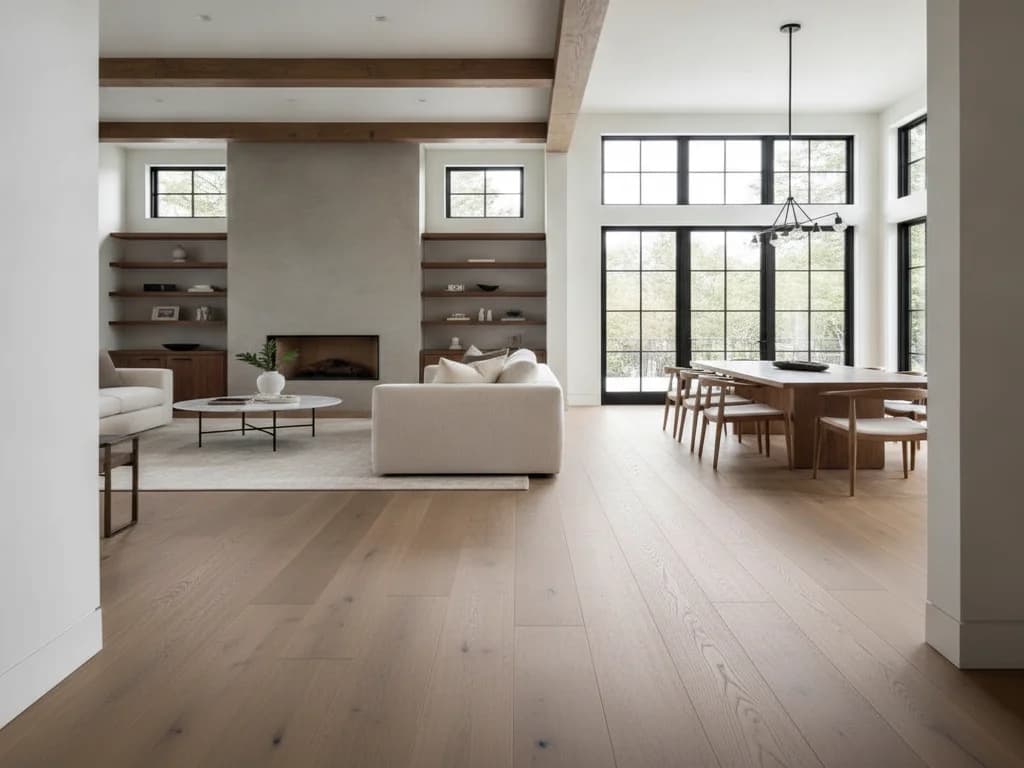
On a solid hardwood floor, sanding can only go down to the top of the tongue — the machined edge that interlocks with the neighbouring board. Below that point there is no longer enough material above the fastener path and the joint, and the board loses integrity. The sandable material is therefore the distance from the current surface to the top of the tongue, and every refinish over the floor's life has spent some of it.
On an engineered floor, the equivalent limit is the wear layer over the core. A thick sawn wear layer behaves much like solid wood at the surface and takes sanding; a thin rotary-peeled veneer does not, and sanding it means sanding through it into the core. This is the specification that determines whether an engineered floor has a second life, and it is invisible once the floor is installed.
The practical ways to find out are straightforward. Lift a floor register or a threshold and look at the exposed edge of a board — you can see the profile, the tongue, and how much material sits above it. Look at the board edge where the floor meets a stair nosing or an exposed transition. In a closet, an inconspicuous test area can be sanded to see how the wood responds. On a floor with a history, an existing gap or a damaged board tells the same story.
Two visual signals suggest the material is running out. If the tongue is visible at board edges or the top of a fastener is showing anywhere in the field, the floor is at or past the end of its sandable range. If board edges are noticeably rounded over — a soft, worn profile rather than a crisp joint — the floor has been sanded aggressively before, and each subsequent pass will exaggerate it.
If your floor is engineered rather than solid, the limit is the wear layer rather than the tongue — our engineered versus solid hardwood guide explains how to tell which you have and what that means.
There is no universal number
The common claim that a solid floor can be refinished a specific number of times is unhelpful, because the answer depends on the original thickness, where the tongue sits in the profile, how aggressively each previous refinish was done, and whether the sanding was done by someone who knew what they were doing. Two floors of the same age in the same neighbourhood can have very different amounts of material left.
How the previous sanding was done matters enormously
A light, controlled sand removes far less material than a heavy pass with coarse grit taken by someone chasing a stubborn stain. Floors that were refinished by careful hands have material left long after floors of the same vintage do not. This is one more reason the assessment has to look at the actual floor rather than reason from its age.
A screen-and-recoat is not a refinish
Abrading the existing finish and applying a fresh coat over it — a screen-and-recoat, or buff-and-coat — removes essentially no wood. It renews a worn finish, restores sheen, and is far quicker and less disruptive than a full sand. It does nothing for damage that has reached the wood, and it will not remove stains, deep scratches, or grey oxidised areas. Where it works, it is the right first move, and it can be repeated over the years without spending the floor's sandable material.
Extending the life you have left
Entry matting, felt pads under furniture, keeping grit off the floor, and recoating before the finish wears through entirely all buy years. The single most useful habit is recoating on a schedule rather than waiting until the wood underneath is exposed — once the wear reaches the wood, a screen-and-recoat is no longer enough.
Refinishing is usually the less expensive and less disruptive path, so it is where we start. These are the conditions where it is not available, and saying so is more useful than selling a sand that will not work.
Replace
- Sanding would go into or past the tongue on a solid floor — there is no material left to remove.
- An engineered floor with a thin veneer wear layer that cannot be sanded at all.
- Water damage that has cupped or crowned boards beyond what sanding can flatten.
- Widespread loose, split, or missing boards, or a subfloor problem beneath that has to be reached.
- Pet damage or staining that has penetrated well below the sandable depth.
- A floor being removed anyway for a layout change, radiant heat, or substrate work.
Refinish
- Surface scratches, dullness, and worn traffic paths through the finish.
- A dated stain colour or sheen on a floor that is otherwise sound.
- Isolated damaged boards that can be replaced and blended into a whole-floor sand.
- Original hardwood revealed after carpet is pulled up — a common and very good outcome.
Northern California's older housing stock produces the best version of this conversation regularly: carpet comes up in a mid-century ranch or a pre-war bungalow and there is original oak underneath in good condition. That floor is very often worth keeping, and refinishing it costs less than any replacement would. Professional practice standards from the National Association of the Remodeling Industry point the same way: recommend the scope the condition warrants.
- 01Assessment — we look at the board profile at a register or threshold, check for exposed tongues or fasteners, and determine whether a full sand or a screen-and-recoat is appropriate.
- 02Preparation — the room is cleared, base or shoe is handled as the plan requires, damaged boards are replaced, and protruding fasteners are set below the surface.
- 03Containment — work areas are isolated with barriers, HVAC returns are covered so dust is not distributed through the ductwork, and equipment is connected to dust-collection systems.
- 04Sanding — successive passes with progressively finer abrasives, working the field with a large machine and the perimeter and corners with edging equipment, until the surface is uniform.
- 05Finish application — stain if the floor is being recoloured, then the protective coats, with the required drying time between them.
- 06Cure and return — the finish takes time to reach full hardness after it is dry to walk on, and furniture and rugs stay off until it does.
Dust containment is the part homeowners ask about most, and it deserves a straight answer. Modern sanding equipment connects to dust-collection systems that capture the great majority of the material at the source, and the difference between that and older open sanding is not subtle. Combined with sealed-off work areas and covered HVAC returns, a well-run refinish keeps dust largely inside the rooms being worked on.
It does not eliminate it. Fine particulate is generated by the process and some escapes any collection system, so expect to clean afterwards and expect to keep sensitive items and people out of the work area during the sanding phase. Anyone who promises a genuinely dustless refinish is overstating what the equipment does.
Finish products also matter for occupancy. Water-based finishes have lower odour and shorter recoat windows than oil-modified ones; oil-modified finishes have their own appearance and durability characteristics and a stronger smell for longer. Which you choose affects how many days the house is uncomfortable to be in, and that is worth deciding deliberately rather than defaulting.
In a home built before 1978, sanding that disturbs painted surfaces brings the EPA's Renovation, Repair and Painting rule into scope, requiring certified firms and lead-safe work practices. This comes up frequently in the region's older housing stock, and it is not something to work around.
The lead requirements come from the EPA's Renovation, Repair and Painting programme, which applies to work disturbing painted surfaces in homes built before 1978.
How do I know if my floor can be refinished again?
Look at the edge of a board where you can see its profile — lift a floor register, look at a threshold, or check where the floor meets a stair nosing. What you are measuring is how much wood sits above the top of the tongue, because that is where sanding has to stop on a solid floor. Two warning signs mean the material is spent: a visible tongue at any board edge in the field, or the top of a fastener showing through the surface. Heavily rounded board edges indicate previous aggressive sanding and less remaining material than the floor's age alone would suggest. An engineered floor has the same question in terms of wear-layer thickness over the core.
How many times can a hardwood floor be refinished?
There is no reliable universal number, and any figure quoted without seeing the floor is guesswork. It depends on the original board thickness, where the tongue sits in the profile, and — most of all — how much material previous refinishes removed. A floor sanded lightly by careful hands has material left long after a same-age floor that was taken down hard with coarse grit. What is true generally is that solid hardwood has more sandable material than engineered hardwood, and that a screen-and-recoat, which removes essentially no wood, can be repeated many times without spending any of the floor's remaining life.
What is the difference between refinishing and a screen-and-recoat?
A full refinish sands through the existing finish and into the wood, removing a thin layer of material, which is what lets it eliminate stains, deep scratches, and grey oxidised areas, and what makes a stain colour change possible. A screen-and-recoat abrades only the existing finish and applies a fresh coat over it — no wood is removed, the job is far faster and less disruptive, and it can be repeated over the years. The trade is that it only addresses finish wear. If the damage has reached the wood, a recoat will lock it in rather than remove it. Recoating on a schedule, before the finish wears through, is the best way to make a hardwood floor last.
Is refinishing cheaper than replacing?
Generally yes, and often substantially, because refinishing avoids demolition, disposal, new material, and the substrate work that a replacement can uncover. It is also less disruptive: nothing is torn out, door clearances and thresholds stay exactly where they are, and transitions to adjoining rooms are unchanged. The reason we still recommend replacement in some cases is that a floor without sandable material left cannot be renewed at any price — sanding it produces damage rather than a fresh surface. We assess the floor and say plainly which situation you are in, including when the answer is the less expensive one.
How much dust does refinishing create?
Less than it used to and more than nothing. Modern equipment connects to dust-collection systems that capture the great majority of the material at the source, and combined with sealed work areas and covered HVAC returns, a well-run refinish keeps most of the dust confined to the rooms being worked on. But fine particulate is generated by the process and some escapes any system, so plan to clean afterwards and to keep sensitive items and people out of the area during sanding. Claims of a truly dustless refinish overstate what the equipment achieves. In homes built before 1978, disturbing painted surfaces also brings EPA lead-safe work practice requirements into scope.
Can I refinish only one room?
You can, and it is a reasonable option where rooms are visually separated by doorways or a change in level. The difficulty is matching: a newly refinished floor will not match an adjacent older one in colour or sheen, because the existing finish has aged and the wood beneath has changed tone with light exposure. Where two areas run continuously into one another with no visual break, a partial refinish will read as a partial refinish. Where there is a door, a threshold, or a turn, it usually reads fine. We look at the sightlines before recommending it, since the answer is specific to how the rooms connect.
Wondering whether the hardwood in your Sacramento, Davis, or Grass Valley home has another refinish in it? We assess the floor you have before recommending anything, right across Northern California. Request a free estimate
The following government agencies, industry organizations, and official resources provide additional information relevant to your remodeling project.